Graphic design trends in 2026 are everywhere — and that’s exactly the problem.
Every time a new design trend explodes on social media, thousands of brands jump on it at the same time. Suddenly your feed is full of the same gradient backgrounds, the same font pairings, the same layout styles. What started as fresh and exciting becomes visual noise within weeks. And somewhere in that noise, your brand disappears.
I’ve been designing social media content long enough to know that chasing trends blindly is one of the fastest ways to make a brand look generic. But ignoring trends completely? That’s just as dangerous. Your content starts feeling dated, the algorithm stops pushing it, and your audience quietly drifts toward brands that feel more current.
The real skill — the one that actually builds brands — is knowing how to use trends without being consumed by them. How to take what’s working visually in 2026 and filter it through your brand identity so the result feels both current and unmistakably yours.
That’s what this blog is about. Let’s get into it.
Why Design Trends Matter More Than Ever in 2026
The visual language of social media moves faster than it ever has. What looked fresh six months ago already feels tired. Audiences have become incredibly visually literate — they can sense immediately whether a piece of conten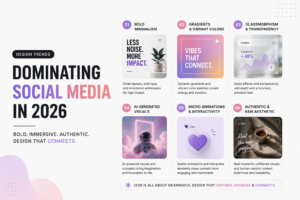 t feels current or whether it’s lagging behind.
Social media design trends aren’t just about aesthetics. They’re signals. When your content looks current, it signals to your audience that you’re paying attention, that you’re relevant, that you understand the space you’re operating in. When it looks dated, it signals the opposite — even if your product or service is exceptional.
The good news is that in 2026, the most dominant graphic design trends are genuinely versatile. They can be adapted to almost any brand without losing brand identity — if you know how to apply them with intention rather than imitation.
Trend 1 — Maximum Typography
If there’s one design aesthetics 2026 trend that has completely taken over social media feeds, it’s bold, oversized, expressive typography.
We’re talking headlines that take up the entire frame. Letters that bleed off the edges. Type used as a graphic element, not just a communication tool. Fonts with personality — condensed, extended, distorted, layered. Typography that makes you feel something before you’ve even read the words.
This trend grew out of a reaction to the clean, minimal aesthetic that dominated the early 2020s. Brands got tired of looking the same. Type became the way to stand out.
How to use it without looking generic: The mistake most brands make with this trend is picking a trendy font and calling it done. The brands executing this well are using typography that feels specific to them — a font weight, a sizing choice, a color combination that nobody else is using in their space.
Start with your brand’s existing font. Push it harder than you normally would. Make it bigger. Make it bolder. Experiment with tracking and leading. You don’t need a new typeface — you need a more confident relationship with the one you already have.
Trend 2 — Raw and Unpolished Aesthetics
This one surprises people, but it’s one of the strongest social media design trends of 2026 — and it has been building for a while.
Audiences are exhausted by perfection. Overly polished, heavily filtered, studio-perfect content has started to feel distant and untrustworthy. In response, raw and unpolished aesthetics have become genuinely aspirational — grainy textures, film photography looks, hand-drawn elements, intentional imperfections, lo-fi layouts that feel human rather than manufactured.
This trend has performed particularly well for lifestyle brands, personal brands, food and beverage, and any category where authenticity is a core value.
How to use it without looking generic: The trap here is going so raw that your content looks accidental rather than intentional. There’s a difference between “deliberately lo-fi” and “just bad design.” The key is controlled imperfection — choose your grain, your texture, your hand-drawn element intentionally. It should feel human, not sloppy.
Also — and this is important — raw aesthetics don’t work for every brand. A financial services firm or a premium luxury brand going lo-fi is going to feel incongruent with their audience’s expectations. Know your brand before you follow this trend.
Trend 3 — Maximalist Color and Pattern
After years of muted palettes and neutral tones dominating visual design 2026, color is back — and it came back loud.
Bold, saturated, clashing color combinations are everywhere in 2026. Unexpected pairings that shouldn’t work but somehow do. Patterns layered on patterns. Gradients pushed to extremes. Color used not as a supporting element but as the main event.
This trend draws heavily from Y2K nostalgia, 90s graphic design, and the growing cultural appetite for joy and energy after years of restrained minimalism.
How to use it without looking generic: Color maximalism is genuinely fun to design with — but it can make your content look chaotic if there’s no underlying system. The brands doing this well are maximalist within a defined palette. They’re not using every color — they’re using their colors, pushed to their most expressive version.
Pick two or three colors from your existing brand palette. Now use them more boldly than you ever have. Bigger blocks. More contrast. Unexpected combinations within your own color family. That’s maximalism with identity — not just visual noise.
Trend 4 — Motion as a Design Element
Static is losing ground fast. In 2026, even brands that primarily create still content are incorporating subtle motion into their social media presence — and it’s changing the way graphic design trends 2026 are being executed.
This isn’t about full video production. It’s about micro-animations. A text reveal. A subtle loop on a background element. A gentle movement that makes a static post feel alive without requiring a full video team to execute.
The platforms are actively rewarding this. Instagram, LinkedIn, and TikTok all surface content with motion over fully static posts in their algorithms — even when the motion is minimal.
How to use it without looking generic: Motion for the sake of motion is just distraction. The most effective micro-animations in 2026 serve a purpose — they guide the eye toward the most important element, they reveal information in a sequence, or they reinforce the brand’s personality through the style of the movement.
A luxury brand’s motion should feel slow and deliberate. An energy drink brand’s motion should feel fast and kinetic. Your motion design is an extension of your brand personality — treat it that way.
The Golden Rule of Using Design Trends in 2026
Every trend I’ve covered here has one thing in common: the brands that make it work are the ones who run it through their brand filter before publishing it.
Not “does this look trendy?” but “does this look like us, today?”
Social media design trends are tools, not instructions. They exist to inspire and expand your visual language — not to replace it. The moment a trend starts making your content look like everyone else’s, you’ve applied it wrong.
The best creative work in 2026 is trend-aware but brand-first. It borrows the energy of what’s current and channels it through something specific, intentional, and genuinely yours.
That’s the difference between content that follows trends and content that sets them.