Content calendar strategy is where most brands quietly fall apart — and nobody talks about it enough.
Here’s what I see all the time. A brand starts strong. Clear visual identity, consistent tone, a posting schedule that actually gets followed. Then a trend hits. Maybe it’s a viral audio on Reels or a meme format taking over TikTok. Someone in the team says “we should do this” and suddenly the brand is chasing every trend that comes along — posting content that looks nothing like them, sounds nothing like them, and confuses the audience they spent months building.
On the flip side, I’ve seen brands so rigidly committed to their brand guidelines that they refuse to touch anything trending. Their content is beautifully consistent and completely invisible because the algorithm isn’t giving it any love.
The answer isn’t one or the other. It’s a system — a content calendar strategy that gives you the structure to stay on-brand while leaving room to move with what’s relevant. And that’s exactly what I’m going to walk you through today.
Why Most Content Calendars Fail
Before we get into the how, let’s talk about why most social media content planning goes wrong.
The most common mistake is planning too rigidly. Brands map out every single post three months in advance and then can’t adapt when something unexpected happens in their industry — or when a trend emerges that would have been perfect for them to jump on.
The second most common mistake is the opposite — planning nothing at all and just reacting to whatever feels relevant that week. This produces inconsistent content, an exhausted team, and a feed that has no coherent identity.
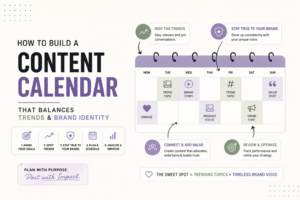
The sweet spot is a flexible structure. A calendar that gives you a clear framework for the month ahead, built around your brand pillars, but with intentional gaps designed for trend-responsive content. It sounds simple. Most brands never actually do it.
Step 1 — Define Your Brand Content Pillars First
You cannot build a content calendar that protects your brand identity if you haven’t clearly defined what that identity actually is.
Before you plan a single post, you need your content pillars — the three to five core themes that your brand consistently talks about. Everything you post should connect back to at least one of these pillars.
For a social media manager and graphic designer, my pillars might look like this: design tips, social media strategy, behind-the-scenes work, client results, and industry trends. Every piece of content I create fits into one of those buckets. That’s what keeps the feed coherent even when individual posts look different from each other.
Brand identity content starts here. Pillars are not just topics — they’re the backbone of your content calendar. Once they’re locked in, planning becomes significantly faster because you’re never starting from a blank page.
Step 2 — Build Your Monthly Framework
Now here’s the actual content calendar strategy I use for clients — and it’s simpler than most people expect.
I work in a 70/20/10 content split:
70% Planned content — posts created in advance, fully aligned with brand pillars, designed and scheduled at least two weeks ahead. This is your consistency engine. It keeps the feed active and on-brand regardless of what’s happening externally.
20% Trend-responsive content — this is the intentional gap I mentioned. These slots are left open in the calendar specifically for trending content. When a relevant trend hits, you have pre-designated space to react quickly without derailing the rest of your schedule.
10% Promotional content — product launches, service announcements, offers. Kept deliberately low because audiences disengage from brands that push sales too hard.
This framework is the foundation of smart social media content planning. The ratio might shift slightly depending on your industry — a fashion brand might do 30% trend content, while a professional services firm might keep it at 10%. But the principle stays the same: structure with intentional flexibility.
Step 3 — Use a Trend Filter Before You Post
Not every trend deserves a spot in your calendar. This is where I see brands make the most damaging mistakes — jumping on trends that have nothing to do with their brand just because everyone else is doing it.
Before adding any trending content to your calendar, run it through this filter:
Does it align with at least one brand pillar? If a trend has absolutely no connection to what your brand stands for, skip it. Chasing unrelated trends confuses your audience and dilutes your identity.
Does it match your brand tone? A luxury brand doing a chaotic, lo-fi meme trend is going to look jarring. Your trending content strategy should feel like a natural extension of your brand — not a costume you put on for the algorithm.
Is there still time to do it well? A rushed trend post that looks sloppy is worse than not posting at all. If you can’t execute it properly within the trend window, let it go. The next one is coming.
Will it make sense in your feed three months from now? This is my personal test. If the post will look completely out of place in your grid or feel embarrassing in hindsight, it’s not worth the short-term reach.
Step 4 — Design Templates That Work for Both
Here’s something most people overlook in content scheduling 2026 — the design side of your content calendar matters just as much as the strategy.
One of the biggest time-savers I build for every client is a set of branded templates for each content type. Trend content, educational posts, promotional content, behind-the-scenes — each category has its own template that’s pre-built with the brand’s colors, fonts, and visual style.
Why does this matter for balancing trends and brand identity? Because when a trend hits and you need to move fast, having a branded template means you can create the trend content quickly and have it still look unmistakably like your brand. The template does the brand work so you can focus on the trend-specific content.
This is the difference between trend content that builds your brand and trend content that dilutes it.
Step 5 — Review and Adjust Monthly
A content calendar is not a document you set and forget. Every month, spend 30 minutes reviewing what worked, what didn’t, and what surprised you.
Which planned posts performed best? Double down on that content type next month. Which trend post got the most reach? Understand why — was it the format, the topic, the timing? Which posts felt off-brand in hindsight? Remove that content type from future planning.
This monthly review is what turns a good brand identity content strategy into a great one over time. The calendar gets smarter every month because you’re feeding it real performance data, not just gut instinct.
A content calendar that balances trends and brand identity isn’t complicated — but it does require intention. The brands that get this right are the ones that show up consistently, look unmistakably like themselves, and still manage to feel current and relevant.
That balance is what separates forgettable social media presence from a feed people actually follow on purpose.