 Let me ask you something. When was the last time you sat through a three-minute video on Instagram without skipping ahead?
Exactly.
We are living in the era of the 7-second decision. People scroll fast, attention is scarce, and if your content doesn’t grab someone in the first blink — they’re already gone. This is why Short-form video design in 2026 isn’t just a trend to follow. It’s the single most important skill you can have as a content creator or social media manager right now.
I’ve spent a lot of time this year figuring out what actually works — not just what looks good in theory, but what genuinely stops the scroll for my clients. And I want to share all of it with you here.
Short-Form Video Isn’t Going Anywhere — Here’s Why
Every year, someone predicts that short-form video is going to die out. Every year, they’re wrong.
In 2026, Reels, TikToks, and YouTube Shorts are still the highest-performing content formats across almost every niche — beauty, finance, food, fashion, fitness, B2B, you name it. The algorithm on every major platform continues to heavily reward short video over static posts. The reach is simply incomparable.
But here’s what’s changed: the bar has gone up. Back in 2021, you could post a shaky, unedited clip with some trending audio and go viral. That era is over. Audiences have seen millions of videos now. They know what good looks like — even if they can’t articulate it. Which means scroll-stopping video content today requires intentional design, not just a good idea.
That’s where the real opportunity is. Most creators are still treating short-form video like a filming challenge. The ones winning are treating it like a design challenge.
Why Design Is the New Differentiator in Short-Form Video
Think about the videos that have stopped your own scroll recently. Chances are, something visual caught your eye before the content even registered.
Maybe it was a bold text overlay. A color palette that felt different from everything around it. A satisfying transition. A thumbnail frame that looked too good to skip. That’s design doing its job — quietly, instantly, without the viewer even realizing it.
Reels design tips that worked two years ago — centered text, white background, basic captions — look dated now. In 2026, the visual language of short-form video has evolved. And if your content still looks like 2022, your engagement numbers are going to show it.
Here’s what the best-performing short-form videos have in common from a design standpoint: they are visually intentional from the very first frame. Every element — the typography, the color, the composition, the pacing — is a deliberate choice. Nothing is there by accident.
How to Design Short-Form Video That Actually Performs
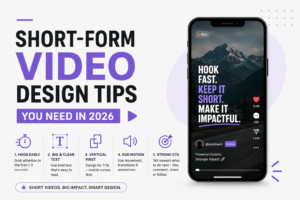
1. Hook Visually in the First 2 Seconds
Your hook isn’t just what you say — it’s what the viewer sees the moment the video plays. Before any words come out of your mouth, the visual frame has already made an impression.
For TikTok graphics and Reels, this means your opening frame needs to earn attention on its own. Use high contrast. Lead with motion. Put bold text on screen immediately. Don’t open with a slow pan or a logo — open with something that makes the viewer’s brain go “wait, what is this?”
A trick I use for clients: design the thumbnail frame first. If that single frame isn’t interesting enough to make someone pause, the rest of the video won’t save it.
2. Typography Needs to Work Without Sound
More than 60% of short-form videos are watched without sound — especially on Instagram and LinkedIn. This means your text overlays are not a nice-to-have. They are your primary communication tool.
Short-form video design 2026 best practice: use large, bold, readable fonts that work at mobile size. Avoid thin serif fonts that blur on small screens. Keep your text short — no more than 6-7 words on screen at once. And please, use contrast. White text on a light background is invisible. Dark text on busy footage is equally unreadable.
Caption design matters too. Auto-captions are everywhere now, but the brands that stand out are the ones customizing their caption style — bold word-by-word highlights, animated text, branded colors. It takes an extra 10 minutes and makes a noticeable difference.
3. Color and Branding Consistency
Here’s something most creators overlook: if someone sees your video without your username, can they tell it’s yours?
That’s the goal with color branding in short-form video. Picking 2-3 brand colors and consistently using them in your text overlays, backgrounds, and graphic elements creates a visual signature. Over time, your content becomes recognizable before anyone even reads your name.
For YouTube Shorts design, this is especially powerful because Shorts are often discovered through the explore page — meaning viewers have zero prior context about who you are. Strong, consistent visual branding does the introduction for you.
4. Motion and Pacing Are Part of the Design
Design doesn’t stop at static elements. The way your video moves is a design decision too.
Fast cuts work for energy and entertainment content. Slower, more deliberate pacing works for educational or high-end brand content. The mistake most people make is using the same editing pace for every video regardless of the content type — and it shows.
For clients in premium or luxury spaces, I always recommend slowing things down slightly and leaning into smooth transitions and clean motion graphics. It signals quality. For lifestyle or entertainment clients, quicker cuts and snappy transitions keep energy high.
Match your editing pace to your brand personality — and be consistent about it.
5. Design for the Format, Not Just the Content
This sounds obvious but it gets ignored constantly: Reels design tips always start with designing for the vertical 9:16 format, not adapting horizontal content to fit it.
Vertical video has its own visual grammar. Key subjects belong in the center or upper-center of the frame. Text goes in the lower or upper third — not in the dead middle where it competes with faces. Leave breathing room at the bottom for the caption and UI elements on TikTok and Instagram.
If you’re repurposing content across platforms — which you absolutely should be — always start with vertical and adapt outward. Never the other way around.
The Takeaway: Design Is Your Competitive Advantage
Most people are focused on what to say in their short-form videos. Far fewer are thinking about how it looks. And that’s exactly where the gap is.
In 2026, scroll-stopping video content is built on design fundamentals — strong visual hooks, readable typography, consistent branding, intentional pacing, and format-first thinking. These aren’t advanced skills. They’re learnable, repeatable, and they compound over time.
If you’re a brand or business posting short-form video and wondering why your content isn’t getting the traction it deserves — nine times out of ten, the answer is somewhere in the design.