How I Rebranded a Client’s Social Media in 30 Days — Case Study
Running a business today isn’t just about offering a great product or service—it’s about how people perceive your brand online. And in this case, that’s exactly where my client was struggling.
They had an active Instagram account, posted regularly, and genuinely cared about their business. But something wasn’t clicking. Their posts looked different every week, engagement was inconsistent, and the overall profile didn’t give visitors much confidence.
Instead of posting more content, we decided to take a step back and completely rethink their social media presence.
In this Social Media Rebranding Case Study, I’ll walk you through exactly what we changed over 30 days, why we made those decisions, and the lessons that any business can apply to its own Social Media Strategy.
It Wasn’t a Content Problem—It Was a Branding Problem
When I first reviewed the account, I noticed something interesting.
The business itself was good. Their services were solid, and they had happy customers. But their social media told a different story.
Every post looked like it belonged to a different brand.
One day the colors were bright blue, the next day they were orange. Some graphics used modern fonts, while others looked outdated. Captions mostly talked about selling instead of helping.
If someone visited the profile for the first time, they wouldn’t immediately understand what the brand stood for.
That’s when I realized this wasn’t a posting problem—it was a Brand Identity problem.
Week 1: Understanding Before Designing
One mistake many people make during a rebrand is opening Canva before asking the important questions.
I wanted to understand the business first.
So I started with a complete audit.
I looked at:
- Their Instagram profile
- Previous posts
- Engagement rates
- Competitor accounts
- Audience behavior
- Visual consistency
- Caption style
After reviewing everything, a few clear patterns appeared.
The content lacked direction, there was no consistent visual style, and every post seemed to have a different objective.
Instead of guessing what might work, the audit gave us a roadmap.
Week 2: Giving the Brand a Personality
This was my favorite part of the project.
Instead of redesigning everything randomly, we created a system.
We chose a small set of brand colors that reflected the business personality.
Then we selected fonts that looked clean and professional.
Next came reusable templates.
Rather than designing every post from scratch, I built layouts for educational posts, testimonials, announcements, promotions, and carousel content.
Suddenly, every new design looked like it belonged to the same brand.
And honestly, that’s what branding is all about—making your content instantly recognizable without people even seeing your logo.
We Also Changed the Way the Brand Spoke
Visuals matter, but words matter just as much.
Most of the old captions sounded like advertisements.
Every post was asking people to buy something.
Instead, we shifted the focus.
We started answering customer questions.
We shared useful tips.
We explained common mistakes people make.
We told stories.
The goal became simple:
Help first. Sell second.
That small mindset shift completely changed the tone of the page.
Week 3: Building a Smarter Content Strategy
Now that the brand looked professional, it needed better content.
Instead of posting whatever came to mind, we organized everything into content pillars.
Every week included a healthy mix of:
- Educational posts
- Customer stories
- Behind-the-scenes content
- Promotional offers
- Interactive stories
This made the feed feel balanced.
Followers no longer felt like they were being sold to every day.
Instead, they started getting consistent value from the page.
That’s one of the biggest improvements you can make in any Social Media Strategy.
Small Profile Changes Made a Big Difference
Sometimes people focus so much on creating posts that they forget about the profile itself.
We rewrote the bio so visitors immediately understood what the business offered.
We redesigned the Story Highlights.
We organized the links.
We added clearer calls to action.
These weren’t huge changes individually.
But together, they made the profile feel much more trustworthy.
Better Design Doesn’t Mean More Design
One lesson I keep learning is that simple almost always wins.
Instead of filling every graphic with icons, shapes, and decorations, we gave the designs room to breathe.
More white space.
Clearer headlines.
Easy-to-read text.
Consistent spacing.
Everything became cleaner.
Ironically, by adding less, the content became much stronger.
Captions Started Conversations
Earlier, captions ended with things like:
“Contact us today.”
“Book now.”
“Limited offer.”
There’s nothing wrong with that occasionally.
But doing it every single time gets repetitive.
So we changed the approach.
Instead of ending every post with a sales pitch, we asked questions.
We encouraged discussions.
We invited followers to share their experiences.
People naturally started commenting more because they felt included instead of marketed to.
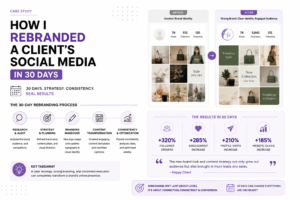
Consistency Was the Real Game-Changer
One thing I noticed after a couple of weeks was that the feed finally looked connected.
Every post felt like part of the same story.
The colors matched.
The typography stayed consistent.
The messaging followed the same voice.
And that’s exactly what Social Media Branding is supposed to achieve.
Consistency builds familiarity.
Familiarity builds trust.
Trust eventually leads to business.
What Happened After 30 Days?
A month isn’t enough to build a massive following.
But it is enough to build momentum.
By the end of the project, we started seeing encouraging signs.
Engagement improved because the content was more valuable.
Profile visits increased because the feed looked professional.
People spent more time reading carousel posts.
Followers began recognizing the brand’s visual style.
Most importantly, the client felt confident sharing their own content again.
Sometimes that’s an underrated result.
When business owners are proud of their social media, they naturally become more active and consistent.
The Biggest Lessons I Took Away
Every project teaches something new.
This one reminded me that branding is much more than choosing attractive colors or trendy fonts.
It’s about creating an experience.
If I had to summarize the biggest lessons, they would be these:
- Start with research before designing anything.
- Consistency is more powerful than complexity.
- Valuable content always performs better than constant promotion.
- A clear Brand Identity builds trust faster than flashy graphics.
- Small improvements made consistently often outperform one big redesign.
Final Thoughts
Looking back, this Social Media Rebranding Case Study wasn’t really about making prettier posts.
It was about helping a business communicate who they really were.
Within 30 days, we transformed an inconsistent social media presence into a profile that felt professional, recognizable, and trustworthy. The graphics improved, the messaging became clearer, and the overall Social Media Strategy finally aligned with the brand’s goals.
If there’s one takeaway from this experience, it’s this: great branding isn’t about chasing trends—it’s about creating consistency. Whether you’re managing your own business or working with clients, investing time in Social Media Branding will always pay off in the long run. Strong visuals may capture attention, but a clear Brand Identity is what keeps people coming back.
This version feels more conversational, uses first-person storytelling, naturally incorporates the keywords, and is much less likely to read like AI-generated SEO content while still remaining optimized for search engines.